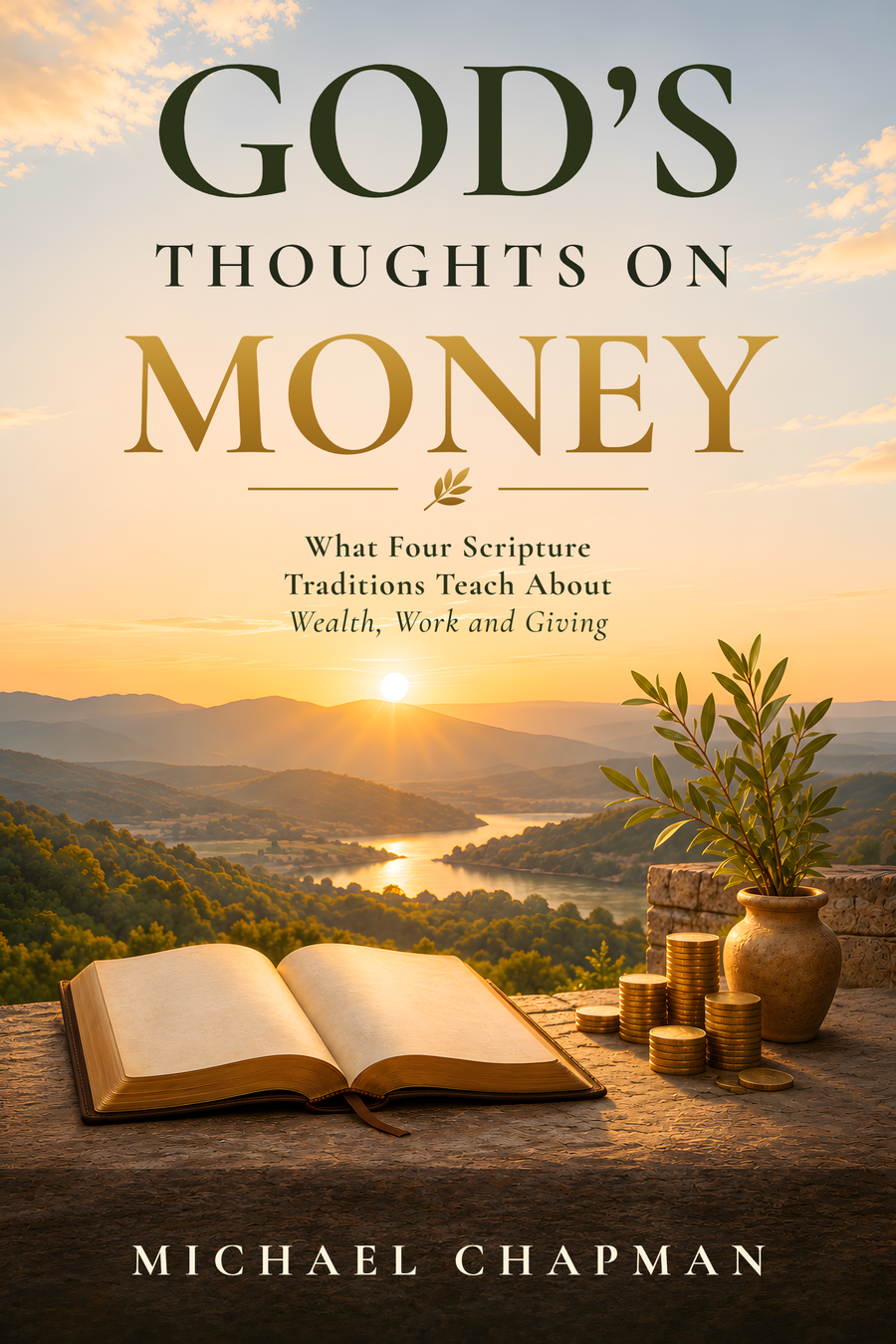
What it is
A reading of what four bodies of scripture say about money: the Hebrew Bible, the New Testament, the Quran and the Latter-day Saint scriptures, with the rabbinic and hadith traditions alongside. Each chapter sets the passages side by side and says where the traditions agree and where they differ.
It is a catalogue, not a claim. The author does not decide whose scripture is right or speak for God. The aim is to read each tradition fairly and let the reader do the weighing.
What’s in each chapter
- The passages themselves, with references
- A plain-language reading of what the traditions share and where they part
- “At the Kitchen Table”: a short, true story from the author’s life or work, with details changed
- Reflection questions for a person, a couple or a study group
The chapters
Part One: Whose Money Is It?
- 1. The Earth Is the Lord’s
- 2. Enough for Today
Part Two: The Danger
- 3. You Cannot Serve Two Masters
- 4. When the Rich Man Forgets
Part Three: The Work of Wealth
- 5. The Faithful Steward
- 6. The Laborer Is Worthy of His Hire
- 7. Just Weights, Honest Hands
- 8. Lending Without Chains
Part Four: The Open Hand
- 9. Give, and It Shall Be Given
- 10. The Least of These
- 11. Justice in the Gate
- 12. Two Mites and a Threshing Floor
- 13. The Tithe and the Storehouse
Part Five: Beyond the Ledger
- 14. What We Leave Behind
- 15. What Money Cannot Buy
An Introduction, a Conclusion (“Treasure”) and an Afterword frame the chapters. Four appendices at the back give the sources and credits, explain how passages are related, sample the passage index, and summarize where the traditions agree and differ.
The complete passage index, with more than 550 passages listed by tradition, by theme and by family, is free on this website: the full Passage Index.
How the book was made
The author’s use of artificial intelligence is described openly in the book’s Afterword.